Noise Surveys Done Right.
Clear Results in 3 Days or less
Take the first step toward OSHA-compliant noise monitoring.
Why Choose Noise Survey Solutions?
Protect your employees
Ensure your team is properly protected from hazardous noise exposure with accurate, reliable and up-to-date data.
Optimize your program
Build or refine your hearing conservation program with practical recommendations based on actual workplace conditions.
Protect your business
Reduce liability, support compliance, and minimize the risk of costly occupational hearing loss claims.
Meet OSHA standards
Confidently meet OSHA 29 CFR 1910.95 noise monitoring requirements with clear, defensible documentation and expert guidance.
The Process
-

1. Request a Quote
Let us know about your facility and needs - we’ll provide a custom quote for your noise survey.
-

2. Schedule an On-Site Survey
Our expert audiologist will conduct a thorough assessment of noise levels throughout your workplace.
-

3. Receive Your Report
Get a detailed, easy-to-interpret report with actionable recommendations for OSHA compliance and best practices.
Your partner in noise monitoring
Expert-Led, Not Technician-Collected
Unlike many environmental firms, every survey is personally conducted by Dr. Luke Grossi, a Doctor of Audiology with specialized expertise in occupational hearing conservation.
That means you don’t just receive data - you get expert interpretation, clear compliance guidance, and actionable recommendations from the person who was on your floor.
Effective hearing conservation programs begin with a noise survey…but not all surveys are created equal.
We go beyond minimum requirements to deliver a clear, accurate picture of employee noise exposure and hazardous sound sources throughout your facility.
About Us
Noise Survey Solutions is focused on one objective: protecting employee hearing while helping businesses confidently manage OSHA compliance and liability.
We provide accurate, real-world noise exposure data and clear guidance to help organizations reduce the risk of occupational hearing loss and associated recordable injuries.
All on-site surveys are conducted personally by Dr. Luke Grossi, Doctor of Audiology - not a technician. Dr. Grossi is certified by the American Speech-Language-Hearing Association and is a licensed course director through the Council for Accreditation in Occupational Hearing Conservation.
This combination of clinical expertise and field experience ensures that every survey delivers not just data, but clear, defensible, and actionable results.

FAQs
-
According to OSHA regulation 29 CFR 1910.95(d)(3), noise monitoring must be repeated whenever changes in production, processes, equipment, or controls could increase employee noise exposure or reduce the effectiveness of existing hearing protection.
Although OSHA does not specify a fixed interval for repeat monitoring, the National Institute for Occupational Safety and Health (NIOSH) recommends repeat monitoring at least every two years when employee noise exposures equal or exceed an 8-hour TWA of 85 dBA.
As a practical best practice, many companies perform updated noise surveys:
Following major equipment or process changes
When expanding operations or production lines
After employee noise complaints
Every 2–3 years for ongoing hearing conservation program management
-
OSHA’s Occupational Noise Standard (29 CFR 1910.95) establishes two primary exposure thresholds; Action Level and Permissible Exposure Limit:
Action Level (AL)
85 dBA as an 8-hour Time-Weighted Average (TWA)
Employees exposed at or above the Action Level must be included in a Hearing Conservation Program.
Permissible Exposure Limit (PEL)
90 dBA as an 8-hour Time-Weighted Average (TWA)
Where employee exposures exceed the PEL, employers must implement feasible engineering and/or administrative controls to reduce exposure levels. Hearing protection is also required until controls are shown to be effective.
Exposure to impulsive or impact noise should not exceed 140 dB peak sound pressure level.
-
Noise-induced hearing loss is influenced by both noise intensity and exposure duration. Because of this, OSHA requires more conservative exposure criteria for extended work shifts.
For shifts longer than 8 hours, the OSHA Action Level must be adjusted downward. Examples include:
8-hour shift: 85 dBA
10-hour shift: 83.4 dBA
12-hour shift: 82.1 dBA
Noise Survey Solutions evaluates employee exposures with respect to applicable shift length to ensure accurate OSHA compliance interpretation.
-
There are two primary instruments used during a workplace noise survey:
Personal Noise Dosimeters
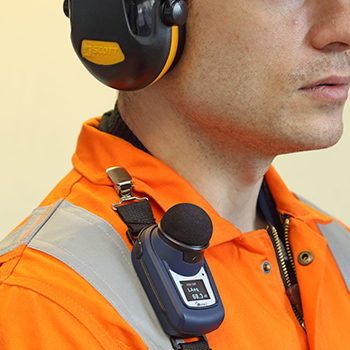
Wireless personal dosimeters are worn by employees throughout the workday to measure cumulative noise exposure and calculate an 8-hour Time-Weighted Average (TWA).
Personal noise dosimetry is the most accurate method for evaluating employee exposure across changing tasks and work areas.
Noise Survey Solutions utilizes Casella dBadge2 wireless personal noise dosimeters for all surveys.
Sound Level Meters
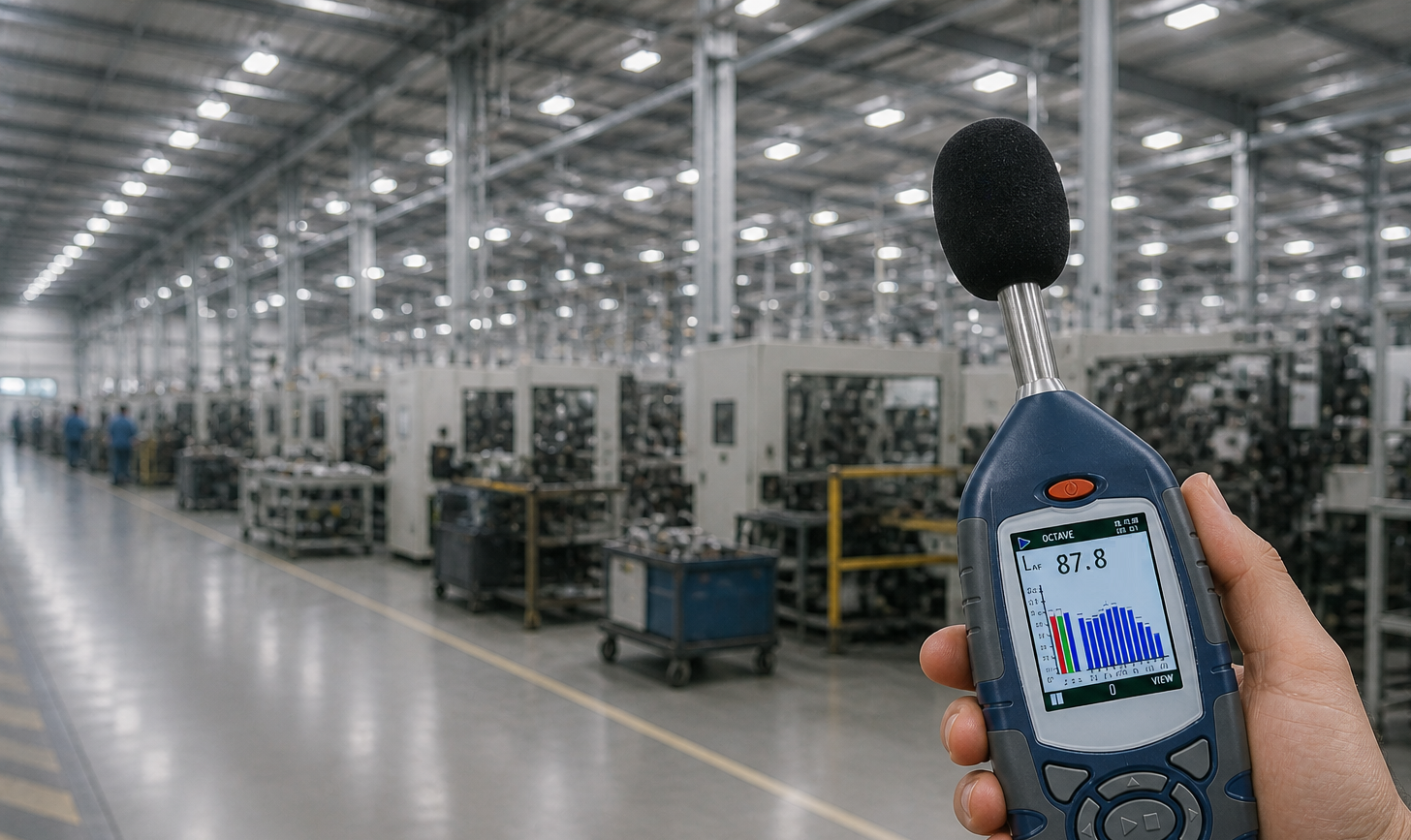
A sound level meter is used to collect targeted measurements from specific machines, tools, processes, and work areas.
These measurements help identify high-noise sources and support engineering control and noise mapping efforts.
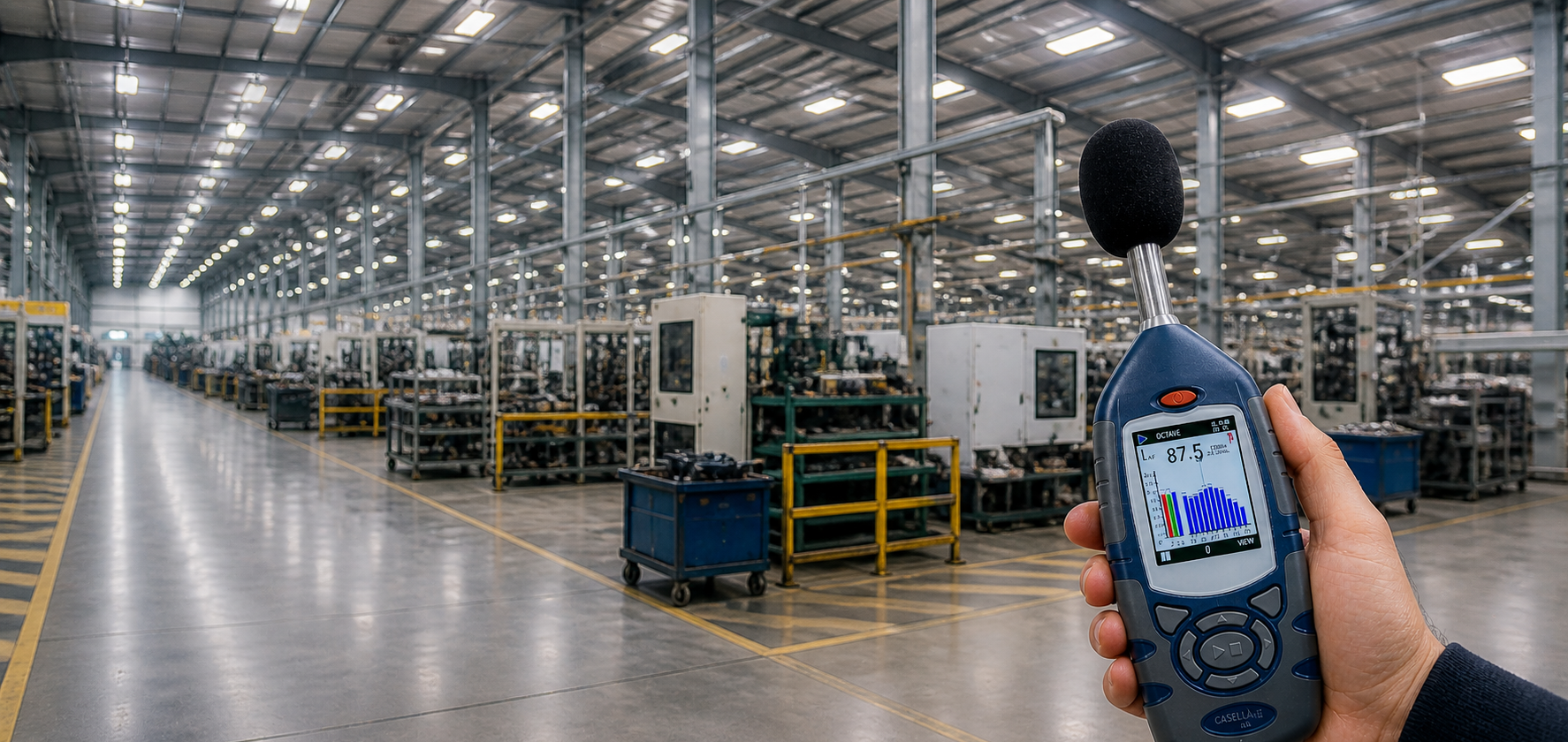
Noise Survey Solutions utilizes a Casella CEL-620 Type 1 integrating sound level meter with octave-band analysis capability.
-
Noise dosimetry measures an employee’s cumulative noise exposure over the course of a work shift and is used to determine OSHA compliance with exposure limits.
Targeted sound level measurements, on the other hand, evaluate noise from specific machines, tasks, or areas within a facility.
Both methods provide important information:
Dosimetry determines employee exposure risk
Sound level measurements identify hazardous noise sources and support noise control efforts
A comprehensive noise survey typically includes both.
-
All of our reports are designed to serve as both compliance documentation and a practical decision-making tool.
All of our reports include:
(10) Personal noise dosimeters
Color-coded exposure charts for easy interpretation
Targeted sound level measurements
OSHA compliance analysis
Hearing protector assessment
Site-specific recommendations and best practices
Calibration documentation
Optional services include:
Noise Mapping
Additional Noise Dosimeters
Hearing Conservation Program development
Our reports are designed to clearly explain findings and help organizations make informed hearing conservation decisions.
-
No. In most cases, employees continue performing their normal job duties throughout the monitoring process.
Personal noise dosimeters are lightweight, wireless instruments designed to measure real-world employee exposure during routine operations.
Because the goal of a noise survey is to evaluate actual workplace conditions, monitoring is typically conducted during normal production activities.
-
Noise monitoring is commonly performed in industries where employees may be exposed to hazardous sound levels, including:
Manufacturing
Food and beverage processing
Metal fabrication and machining
Plastics and injection molding
Utilities and energy
Warehousing and distribution
Construction materials and aggregates
Transportation and heavy equipment operations
Any workplace with significant machinery, compressed air systems, impact tools, or sustained production noise may require evaluation under OSHA’s hearing conservation standard.
-
Yes. Noise Survey Solutions can develop visual noise maps that plot measured sound levels throughout a facility.
Noise mapping can help:
Identify high-noise areas
Support engineering control evaluation
Improve employee communication and signage
Assist with hearing protection policies and program management
Noise mapping is available as an optional service.
-
No. Noise Survey Solutions does NOT provide residential noise testing, neighborhood noise complaint investigations, or local noise ordinance/compliance monitoring.
Our services are strictly focused on occupational noise exposure assessment, employee safety, and OSHA hearing conservation compliance.